
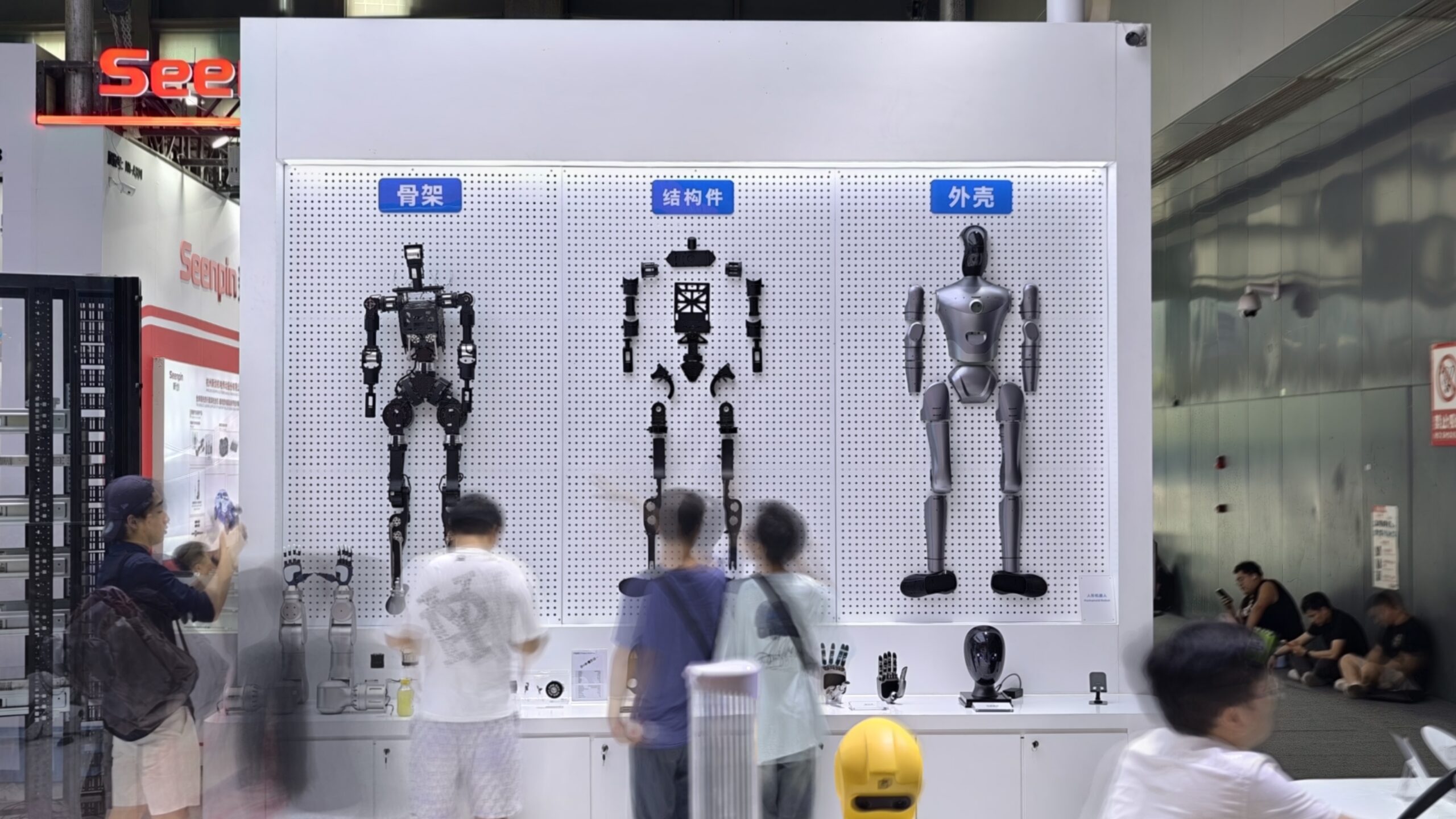
IFA 2026 offers a powerful snapshot of how far Chinese technology companies have come in Europe.
According to figures cited in coverage of this year’s show, 928 exhibitors from mainland China and 84 from Hong Kong attended IFA 2026, bringing the total number of Chinese exhibitors to more than 1,000 out of roughly 1,900 exhibitors.
That scale reflects China’s considerable strengths in engineering, manufacturing, supply chains and product development.
IFA is one of the best places to demonstrate those strengths. Buyers can touch the product, test it, compare it and judge whether it performs reliably in real homes and real environments.
For many Chinese technology companies, that remains indispensable.
At the same time, the next phase of internationalization is becoming more complex. As products become connected, software-enabled and AI-assisted, success increasingly depends on the broader ecosystem surrounding the hardware.
IFA remains important because it proves the product
One of the clearest lessons from IFA 2026 is how practical the European market remains.
European buyers and distributors tend to evaluate technology through real-world outcomes. Robot lawnmowers have to mow properly on wet or uneven terrain. Robot vacuums have to reach difficult corners. Smart appliances have to fit European homes, usage habits and service expectations. As one Chinese tech influencer quoted,
“In Shenzhen, if your PPT doesn’t have two pages on embodied intelligence, investors may ignore you. In Berlin, if you don’t mow the lawn properly, the customer walks away.”
Technology still matters, but primarily because of what it enables.
This makes IFA highly valuable for demonstrating product-market fit, improving distributor confidence and showing that a product is commercially ready.
More than 1,000 Chinese exhibitors also create an attention challenge
The scale of Chinese participation creates a parallel challenge.
When more than 1,000 companies from mainland China and Hong Kong are exhibiting within the same event, simply having a presence no longer creates much differentiation.
For many brands, international exhibitions can easily become habitual: competitors attend, so the company attends; competitors increase booth size, so budgets rise accordingly.
A more useful approach is to assign different objectives to different conferences.
IFA can be highly effective for distributor recruitment, retailer engagement, product demonstrations and building confidence in European consumer markets.
Other platforms can complement that role by helping companies build relationships with the software, technology, investment and service ecosystems surrounding those products.
Chinese hardware strength does not automatically translate into a strong software experience
Chinese companies have become exceptionally competitive in physical products.
Drones, appliances, robotics, battery systems, cameras, mobility products and other hardware categories increasingly demonstrate world-class engineering.
But the consumer experience no longer ends with the device.
A connected product also includes an app, account system, cloud services, software updates, APIs, integrations, data storage and customer support.
This is often a more difficult part of internationalization.
Digital products originally developed for China can carry assumptions that do not transfer directly to European markets. Chinese interfaces often prioritize feature density and multifunctionality, while many Western UX conventions emphasize clearer information hierarchy, fewer visible choices and simpler user journeys.
Neither approach is inherently superior, but localization requires substantially more than translation.
Software may need to be redesigned around different usage patterns. Navigation and onboarding may need to change. Terminology has to work naturally in multiple languages. Customer-support flows also need to be adapted.
Europe magnifies the challenge because there is no single European language market.
German, French, Spanish, Italian, Portuguese, Dutch, Polish and other localized versions all have to feel credible. Spelling or translation errors that look minor in promotional materials become much more damaging when they appear inside account settings, safety instructions, payments or product controls.
International software therefore becomes a product-development investment rather than simply a translation expense. Chinese smartphones in Europe are often scrutinize for their lack of localization and language mistakes despite an amazing hardware experience through its design and camera functionality.
Xiaomi shows how localization extends all the way to infrastructure
Xiaomi provides a practical example of how a Chinese hardware company has had to adapt its underlying infrastructure for different markets.
For users in the European Economic Area, Xiaomi states that data for services including Xiaomi/Mi Home and Mi Fitness is stored with Amazon Web Services in Germany, while its privacy framework identifies a Netherlands entity as the EEA data controller. Xiaomi also states that transfers of EEA personal data outside the region are governed by EU Standard Contractual Clauses.
Source: https://trust.mi.com/docs/iot-privacy-white-paper-global/4
That is an important illustration of the hidden investment behind international hardware expansion.
The physical device may be largely the same globally, but the cloud infrastructure, legal structure, data flows and software operations surrounding it cannot simply be copied from the domestic market.
These capabilities become part of the product.
GDPR is now only one part of a wider European technology policy
GDPR already forces connected-device companies to consider data minimisation, consent, storage, access and international data transfers during product design.
Europe is now moving further.
In June 2026, the European Commission introduced a European Technological Sovereignty Package covering semiconductors, AI, cloud computing and open-source software. The stated aim is to strengthen European digital autonomy and reduce structural dependencies on non-EU providers in critical technologies.
A central part of the package is the proposed Cloud and AI Development Act (CADA).
Among other measures, CADA proposes a common EU framework for assessing cloud and AI sovereignty. The framework ranges from data being processed and stored within the EU to higher levels requiring greater independence from third countries, transparency over software supply chains and, at the highest level, protection from third-country interference.
Source: https://digital-strategy.ec.europa.eu/en/library/proposal-cloud-and-ai-development-act-cada
The direction is significant for Chinese technology companies.
European customers and partners will increasingly evaluate not only product performance but also where data is stored, which cloud infrastructure is used, who controls the software stack and how dependent a service is on providers outside Europe.
The Commission has already begun applying similar principles in its own cloud procurement. Its Cloud Sovereignty Framework evaluates suppliers across 48 criteria, including jurisdiction, data and AI, supply chains, technological autonomy, security and compliance.
Source: https://commission.europa.eu/news-and-media/news/sovereign-cloud-framework-explained-2026-06-01_en
For connected hardware companies, software architecture, compliance and local partnerships are therefore becoming strategic commercial issues.
Huawei provides another useful lesson: hardware becomes stronger when developers can build around it
Huawei’s experience in Europe illustrates another dimension of the same problem.
Rather than treating its devices purely as finished hardware, Huawei invested in building a developer ecosystem around Huawei Mobile Services.
The company held its first European Huawei Developer Day in 2019 and opened its platform to developers through services including HMS Core, AI capabilities, AR and Camera Kit. Huawei said its Mobile Services ecosystem had more than 38 million European users at the time.
Source: https://www.huawei.com/en/news/2019/5/the-first-huawei-developer-day-europe
It also established DigiX Labs, including a lab in Düsseldorf, where developers and partners could test applications and access Huawei technologies. Huawei subsequently worked with local companies such as Spanish streaming service Filmin to integrate European content and services into its ecosystem.
Source: https://www.huawei.com/en/news/2019/8/huawei-developer-conference-2019
By the end of 2021, Huawei reported more than 4 million registered HMS developers globally and over 134,000 apps connected to HMS Core.
Source: https://www.huawei.com/en/news/2021/6/developer-hms-appsup
The broader lesson is not specific to smartphones.
A connected hardware product becomes more valuable when other companies can build services around it.
The growth model is becoming less linear
The traditional consumer hardware model was relatively straightforward:
Manufacturer → Distributor → Retailer → Consumer
That structure remains important.
Connected products increasingly add another layer:
Hardware → Software → Developers → Platforms → Services → Consumer
A robot, wearable, appliance or AI device may eventually need to interact with cloud platforms, smart-home services, telecommunications networks, enterprise software, payment systems or local service providers.
Building every capability internally is rarely the most efficient strategy.
For many Chinese technology companies, partnerships with local developers, SaaS providers, cloud companies, cybersecurity specialists and established platforms can accelerate localization while reducing the need to recreate an entire ecosystem market by market.
This makes developer access and ecosystem relationships increasingly important differentiators in hardware adoption.
IFA and Web Summit address different parts of the same internationalization process
IFA excels at demonstrating that a product is ready.
A distributor can inspect it. A retailer can compare it. A customer can try it. A manufacturer can demonstrate why the technology works.
Web Summit creates a different environment.
Its audience spans software, AI, cloud, startups, investment, enterprise technology, media and government.
At Web Summit 2025, 71,386 participants from 157 countries attended Lisbon, including 1,857 investors from 86 countries, 2,725 startups from 108 countries, 268 government delegations from 82 countries and more than 1,500 members of the media.
Source: https://websummit.com/blog/news/record-investors-at-web-summit-2025-bucking-industry-trends/
For a Chinese hardware company, this creates relationships around the product rather than replacing traditional product and distribution conversations.
A European distributor may be found at IFA.
At Web Summit, the same company may meet a cloud partner supporting its European infrastructure, a developer building a new application around the device, a SaaS company providing an integration, an investor financing international expansion, or an international media organization helping explain the brand to a wider audience.
The two platforms are complementary.
Networking also extends beyond exhibition space
Traditional exhibitions naturally concentrate activity around booths.
Web Summit places greater emphasis on interaction across the wider event through curated meetups, investor sessions, media activities, side events and informal gatherings.
This produces a different networking dynamic.
Rather than relying predominantly on visitors walking past a stand, companies can build relationships through repeated interactions across an entire technology community.
That matters particularly in markets where trust, local relationships and long-term commitment influence commercial decisions.
Lisbon also opens a wider geographic network
IFA naturally has particular strength across European consumer electronics and retail.
Lisbon offers a different geographic mix.
Web Summit attracts participants from Europe, North America, Latin America, the Middle East, Asia and other regions.
Portugal’s historical and linguistic relationship with Brazil adds another useful dimension. The connection has become more tangible through Web Summit Rio, which attracted more than 40,000 participants from over 100 countries in 2026.
The Rio edition also included dedicated networking around China–Latin America technology partnerships, showing how the Lisbon and Rio ecosystems increasingly intersect.
For Chinese companies with ambitions across both Europe and the Americas, Lisbon can therefore serve as a broader international networking hub rather than solely a European market-entry event.
From exporting hardware to building international products
The presence of more than 1,000 Chinese exhibitors at IFA is ultimately evidence of success.
Chinese companies have demonstrated that they can build globally competitive physical products at remarkable speed and scale.
The next stage requires those products to work naturally within different software environments, languages, regulatory systems and consumer behaviors.
That requires more than hardware engineering.
It requires developers, software partners, cloud infrastructure, cybersecurity expertise, compliance capabilities, local service providers and international business relationships.
IFA remains an important place to demonstrate that the hardware is ready.
Web Summit provides a complementary environment for developing more of the ecosystem surrounding that hardware.
As Chinese technology companies move from exporting products toward building international businesses, the distinction becomes increasingly important.
The hardware creates the initial opportunity. The ecosystem around it increasingly determines adoption, trust and scale.